Tankless vs Tank Water Heater: Which Fits a Chester County Home?
There is no single best water heater. The right one depends on how many people live in the house, how they use hot water, what fuel is available and how long you plan to stay.
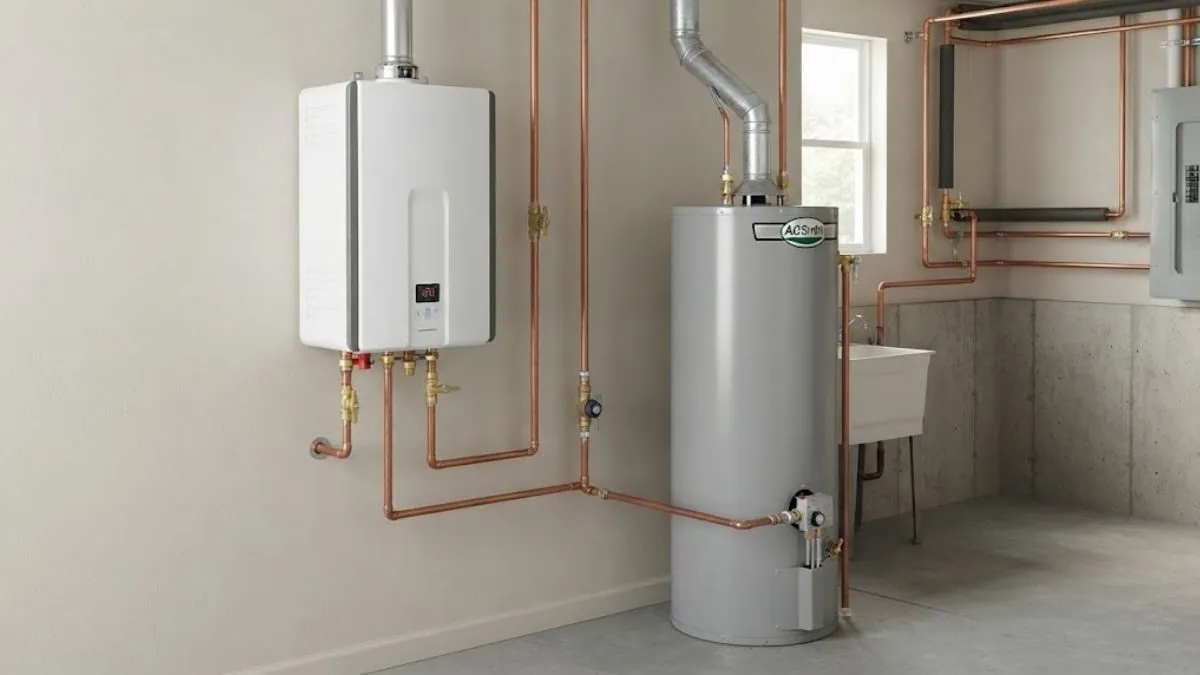
The three types in plain terms
A tank heater stores heated water and keeps it hot. A tankless heater heats water only when you open a tap. A heat pump water heater uses electricity to move heat from the surrounding air into the tank, which uses far less energy than heating by resistance but needs room and airflow.
Each solves a different problem. Tank heaters are simple and cheap. Tankless units save space and never run out in a single use. Heat pump units cut electric bills.
How the three compare
| Tank | Tankless | Heat pump | |
|---|---|---|---|
| Upfront cost | Lowest | Highest | Higher than tank |
| Running cost | Standby loss | Lower for light users | Lowest on electricity |
| Space | Needs floor space | Wall-mounted, compact | Needs space and air |
| Hot water supply | Runs out after the tank volume is used | Continuous, flow-limited | Tank volume, slower recovery |
| Typical lifespan | About 10 to 15 years | Often 20 years with care | Similar to tank |
| Maintenance | Anode check, occasional flush | Descaling, inlet filter | Air filter, condensate drain |
Questions that point to the right type
How many people live in the house, and do they shower at the same time? A family of five with two simultaneous showers and a dishwasher running may exceed a small tankless unit's flow rate, while the same load on a 50-gallon tank works as long as the tank has recovered.
How long will you stay? A tankless unit costs more upfront, and the savings take years to repay. If you will move in five years, the extra cost may not come back. If you plan to stay for decades, the longer lifespan helps.
Water heater failing soon?
Call for a quote on a like-for-like tank or a conversion.
Things that change the plan
Water quality and your new heater
Aqua Pennsylvania's 2025 report for the West Chester system lists Brandywine Creek and two wells as the sources and does not publish hardness. If you see white scale on fixtures or in the kettle, test your water. A softener can protect any heater, and tankless owners in particular should plan for periodic descaling.
Replacing a water heater compares the three types for your layout, and servicing a tankless unit explains how descaling and error code checks work if you already own one.
A note for East Bradford homes
East Bradford houses range from older homes with basement utility rooms to newer builds with closets and garages. The location of the existing heater often decides the options. A basement tank can be replaced with another tank easily. A tankless conversion works well on a basement wall with a good vent path, and a heat pump unit suits a large basement with space around it.
Running the numbers without a spreadsheet
Operating cost is where the types diverge, but the gap depends on use. A tank heater loses a little heat all day because the stored water cools slowly and has to be reheated. A household that uses little hot water pays for that standby loss without getting much benefit. A tankless unit heats only on demand, so a light-use household saves the most.
For a busy household, the difference narrows. If hot water runs for hours every day, the savings from skipping standby loss are a smaller share of the total bill. This is why the same unit can be a good choice for a retired couple and a marginal one for a family of six, and why a plumber will ask how the house uses water before recommending anything.
Which household fits which heater
| Household | Likely best fit | Reason |
|---|---|---|
| One or two people, light use | Tankless or a small tank | Low demand, standby loss is the main waste |
| Family with staggered showers | Tank or tankless | Either works, so cost and space decide |
| Large family, simultaneous use | Larger tank or two tankless units | A single small tankless unit may be overwhelmed |
| Home with tight utility closet | Tankless | Wall-mounted units free floor space |
| All-electric home, large basement | Heat pump water heater | Cuts electric use if there is room and airflow |
What the install actually involves
A like-for-like tank swap usually means disconnecting water, gas or power, venting and the relief line, then connecting the new unit in the same place. A tankless conversion also means mounting the unit on a wall, running new venting through a wall or the roof, upsizing the gas line if needed, and installing service valves for future flushing.
A heat pump unit is closest to a tank in how it connects, but it needs a drain for condensation and clearance around it for air. Whichever you choose, ask the plumber to list every item in the quote, from the unit to the vent kit to the permit, so the comparison between bids is fair.
Questions worth asking before you sign
Ask what the manufacturer's warranty covers for the tank or heat exchanger and for parts, and what labor warranty the installer offers separately. Ask whether the quote includes an expansion tank, a drain pan and removal of the old unit. And ask what routine maintenance the new unit will need, since a tankless unit that is never descaled loses efficiency, and a tank that is never flushed collects sediment.
A good answer is specific. A vague one is a reason to ask someone else.
Hot water you can feel versus hot water you can measure
Ask for the numbers behind a recommendation. For a tank, that means the first-hour rating, which tells you how much hot water the unit delivers in an hour of heavy use. For a tankless unit, it means the flow rate in gallons per minute at the temperature rise your incoming water requires. Cold winter water needs a bigger temperature rise than summer water, so a unit that handles two showers in August may struggle in January.
A plumber can add up the fixtures you use at once and pick a unit with margin. That calculation takes minutes and prevents the most common complaint after a tankless install.
Where to go next
Pricing and options sit in the replacement process for a water heater, upkeep in more on this topic, and the East Bradford page covers local housing types.
Sources and standards
Sources: manufacturer installation guidelines for tank, tankless and heat pump water heaters, and the plumbing code the municipality enforces. Ratings such as first-hour rating are published according to industry test standards.
Tankless vs tank questions
For light users it can be. For heavy users the savings shrink.
Often yes, but gas, venting and electrical supply must be checked.
Often about 20 years with regular descaling.
They work, but they cool the space and run best where there is some warmth.
A like-for-like tank swap is usually the lowest cost.