Old Pipes in Chester County Homes: Galvanized, Polybutylene and When to Repipe
Pipes do not last forever, and the material your house was plumbed with decides how it ages. Knowing what you have helps you decide between patching and replacing.
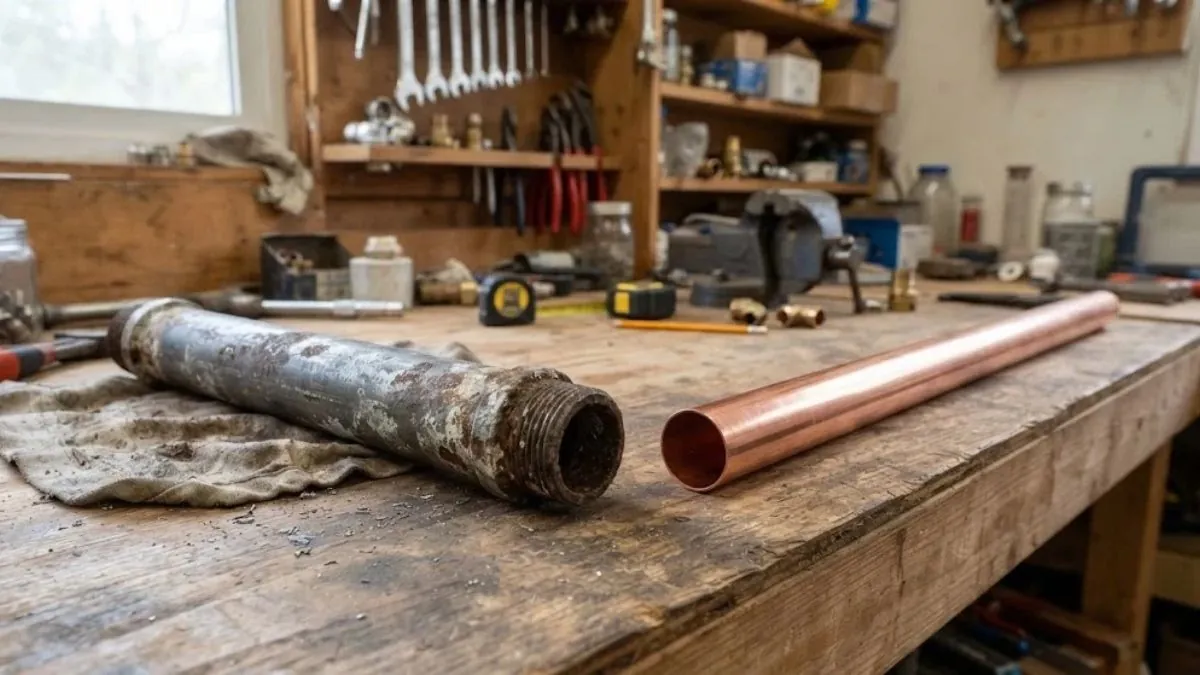
Know your pipe
Houses in the West Chester area span several centuries and several plumbing eras. Some have copper from the 1970s onward. Some have galvanized steel from mid-century.
Some have polybutylene, a gray plastic used in the late 1970s to the mid-1990s, or CPVC and PEX from later years. Older houses can have all of these in different parts.
Each material fails differently. Galvanized pipe corrodes from the inside and narrows over decades. Polybutylene has a record of failing at fittings.
Copper can pit or develop pinholes in some water chemistry. Knowing which you have tells you what to watch.
How to recognize common pipe types
| Material | Appearance | Quick test |
|---|---|---|
| Copper | Brown or green, rigid | A magnet does not stick |
| Galvanized steel | Dull gray, threaded joints | A magnet sticks and a scratch shows silver |
| Polybutylene | Gray, blue or black flexible plastic, often stamped PB | Look for PB2110 marking |
| CPVC | Cream or light yellow, rigid | Rigid plastic, solvent-welded joints |
| PEX | Red, blue or white flexible tubing | Flexible with crimp or clamp fittings |
Signs the pipes are wearing out
Seeing these signs?
Call and book an assessment.
Patch, phase or repipe
One leak in an old pipe is a repair. Several in a year is a pattern. The cost of repeated repairs, plus the damage each leak does, often exceeds the cost of replacing the pipe. A whole-house repipe replaces the supply lines through the house, usually with copper or PEX.
Some owners phase the work, replacing the worst section first. That spreads the cost but opens walls more than once. The right choice depends on the house, the budget and how much risk you can accept.
Before you decide, find the actual leaks
Not every sign of trouble means the whole house needs repiping. A single pinhole leak in one section may be the only problem. Hidden leak detection finds where water is escaping and shows how widespread the damage is. If the rest of the pipe tests sound under pressure, a spot repair may be enough.
On the other hand, if testing shows weak points in several places, the decision gets easier. A plumber should show you the evidence, not just recommend replacement.
Old houses in West Bradford
West Bradford has historic districts in Marshallton, Trimblesville and Northbrook, and many older houses elsewhere in the township. A house with roots in the 18th or 19th century has usually been updated several times, so the plumbing is a patchwork. That is not necessarily a problem. It does mean a repipe in such a house is planned room by room, with care for old plaster and trim.
Lead and the utility side
Aqua Pennsylvania's West Chester report notes a service line inventory at aquawater.com/leadmap, and says it cannot control the plumbing materials inside your home. Tap sampling in 2025 detected no lead at the 90th percentile. If you own an older house, the supply line from the street and the pipe inside both deserve attention. Replace the part you control.
What the water tells you
Water that runs rusty for a few seconds first thing in the morning, then clears, often means old steel pipe or an iron-bearing fitting somewhere in the house. Water that stays brown, or that stains laundry and fixtures, points to a larger problem with the pipes. A slow drop in pressure over years, especially when a new tap on the same floor flows normally, is the classic sign of galvanized pipe narrowing inside.
Plumbers can tell a lot from a simple flow test. Measuring flow at a tap and comparing it to the static pressure shows how much the pipe is restricting. A house with good static pressure and poor flow has a restriction in the piping, and that is evidence for repiping rather than guesswork.
What a repipe quote should break out
| Item | Why it matters |
|---|---|
| Pipe material and fittings | Copper and PEX differ in cost and lifespan |
| Number of access holes and their size | Determines drywall repair needs |
| Fixtures and shutoff valves replaced | Old valves are often replaced at the same time |
| Permit and inspection | Needed in most municipalities |
| Wall and ceiling repair | Sometimes included, often separate |
| Warranty on pipe and labor | Compare the terms, not only the length |
| Schedule and water-off periods | Affects daily life during the work |
Living through a repipe
A repipe takes several days, but the house is usually not unusable. The water is off for part of each workday and restored in the evening for most projects. Crews place drop cloths, cut small access holes in the drywall and run new lines from a central point to each fixture.
Plan for dust and noise, and move fragile items away from the walls being opened. Ask where the crew will park and where they will store materials. If anyone in the house depends on water for medical reasons, tell the contractor in advance so the schedule can allow for it.
Insurance, resale and the long view
Some insurers ask about the age and material of plumbing, and a few will not cover or will surcharge a house with polybutylene or old galvanized pipe. Checking with your insurer before and after a repipe can show whether the work changes your premium or your coverage. At sale time, a documented repipe with a permit and a warranty is easier for a buyer to accept than a house with undisclosed old pipe.
None of this means every old house needs a repipe now. It means the decision should be made with evidence, in the open, before a leak forces it.
Partial replacement as a middle path
Between patching and a full repipe sits a partial option. Replacing the main supply from the shutoff to the first branch, or the worst-affected bathroom line, can restore pressure and remove the most failure-prone sections. This works best when testing shows the rest of the system is in decent condition.
Ask the plumber to explain what would still be old after the work and what the likely next failure would be. A partial job that leaves a known weak link is a fair choice if you understand it.
Where to go next
Testing comes first in hidden leak detection and the replacement itself in the repipe process, and West Bradford covers historic districts.
Sources and standards
Sources: Aqua Pennsylvania's 2025 West Chester report on service line inventory and lead results, and pipe manufacturer standards such as ASTM and NSF/ANSI 61 for drinking water contact.
Old pipe questions
Often several decades, depending on the water and the pipe. They narrow and corrode as they age.
It has a record of failing at fittings. Many owners replace it.
Water is off for part of each day and walls are opened in places. Ask about patching.
Both are accepted. PEX is flexible and less likely to split in freezing.
In most places, yes. The plumber usually arranges it.