Should You Scope the Sewer Line Before Buying a House in Chester County?
A home inspector checks what they can see. The sewer lateral runs underground, so it is usually missed. A camera scope is the one inspection that looks at it.
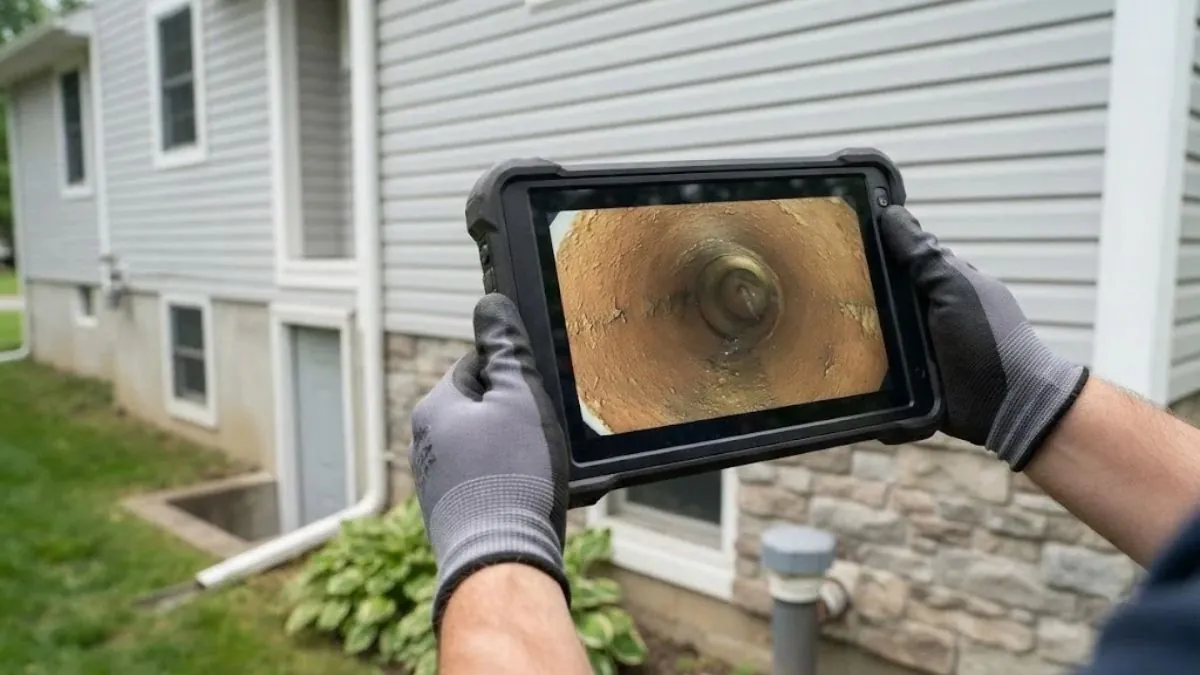
What a home inspection leaves out
A standard home inspection covers the visible parts of a house: the roof, the foundation, the electrical panel, the water heater and the fixtures. It generally does not include the buried pipe that carries wastewater from the house to the street or to a septic tank. That pipe is out of sight, out of reach and out of the inspector's scope.
The lateral is typically the owner's responsibility from the house to the point where it joins the public main. If it is cracked, full of roots or collapsed, repairing it can be a large unplanned cost. A scope before closing turns that risk into a number you can negotiate.
What a camera can find in a sewer lateral
| Finding | What it means | Typical consequence |
|---|---|---|
| Roots in joints | The pipe has openings | Repeat clogs, possible repair or lining |
| A belly or sag | Part of the pipe has sunk | Standing water, repeat clogs, section replacement |
| Cracks or breaks | The pipe is damaged | Leaks into the soil, repair or lining |
| Offset joints | Pipe sections are misaligned | Debris catches, spot repair |
| Orangeburg or heavy scale | Old or failing pipe material | Replacement planning |
| Clean, smooth pipe | Line is in good condition | No action needed |
What Pennsylvania seller disclosure does and does not cover
Pennsylvania's Real Estate Seller Disclosure Law requires sellers to disclose known material defects, and the standard form asks about the sewage system. That disclosure only covers what the seller knows. A line that has never been scoped may have defects the owner has never seen.
A scope fills that gap. If it finds nothing, you buy with confidence. If it finds a problem, you can ask for a repair, a credit or a lower price, or you can walk away informed.
How to schedule and use a scope
Ask for it early
Include the scope in the inspection period so there is time to negotiate.
Make sure there is access
A cleanout makes the scope straightforward. If there is none, a toilet may have to be pulled.
Get the recording
Ask for the video and a written note with the distance to each defect.
Get a repair quote
If a defect shows up, ask for a quote so you can negotiate with a real number.
Decide
Weigh the repair against the price, and decide whether to proceed.
Buying a home soon?
Call and ask about a sewer camera inspection.
Septic properties need a different check
If the house is on a septic system rather than public sewer, the inspection is different. The tank, the baffles and the drainfield need to be checked, usually after a pump-out. The Chester County Health Department holds permits for on-lot systems, so ask for the permit record and the last pumping receipt. In townships such as East Goshen, some streets are on public sewer and some on septic, so confirm which applies before you write the offer.
Using the result
A bad scope is not a deal breaker. It is information. A quote for sewer line repair options or lining gives you a number to bring to the table. A clean result is also valuable: keep the recording as a baseline for future work.
Either way, a sewer camera inspection costs a small fraction of the repair it might uncover. For a house in an area with older trees and older lines, it is among the most useful checks you can buy.
How a seller's age of house shapes the odds
The older the house, the longer the lateral has been in the ground, and the more materials it may have passed through. A 1950s house may have clay or cast iron. A 1970s house may have cast iron or early plastic.
Some mid-century houses were piped with Orangeburg, a pressed-fiber pipe that softens over time and can deform. A later repair may have joined old and new materials at one connection, and that joint is a common failure point.
None of this guarantees a problem. Many old laterals work fine for decades. But the odds of a defect rise with age, and a camera is the only way to see it. For a house built before the 1980s, a scope is one of the cheaper ways to reduce uncertainty at closing.
Reading the result when you are the buyer
Treat as a negotiation item
- Roots in a joint but a sound pipe otherwise
- A short offset or crack with a spot repair quote
- Scale in cast iron that jetting could address
- A missing cleanout, which is cheap to add
Treat as a serious concern
- A collapsed or crushed section
- A long sag holding water
- Multiple failing joints along the line
- Pipe material known to be failing, such as Orangeburg
A repair quote in hand turns the finding into a number. That number can be a credit at closing, a repair before closing or a reason to walk away.
Timing the scope with the inspection period
Most purchase contracts have a short window for inspections and for negotiating repairs. A sewer scope should be ordered as soon as the contract is signed, because scheduling, the video review and any follow-up quote take days. Ask the seller's agent whether a cleanout exists and whether the water will be on for the scope, since the plumber needs to run water to see how the pipe drains.
If the scope finds a problem late in the window, ask your agent about extending the period or negotiating the repair as a contingency. Do not skip the review because time is short.
After you own the house
Keep the recording and the written notes with your home records. If the scope was clean, scope again in several years or when symptoms appear, and compare to the baseline. If you made repairs, keep the invoice and any warranty. The record helps if a problem arises later and supports the value of the house when you sell it.
Questions to ask the scoping plumber
Where to go next
To book the scope see more on this topic, to price a fix see the choices for a failing sewer lateral, and for a purchase near the borough line read the East Goshen page.
Sources and standards
Sources: Pennsylvania's Real Estate Seller Disclosure Law form, and the Chester County Health Department for on-lot permit records.
Pre-purchase sewer scope questions
Usually not. It is a separate inspection.
About an hour for a straightforward line.
Typically the buyer, though sellers sometimes agree to it.
You can negotiate a repair, a credit or a lower price.
Often, by pulling a toilet or going through a roof vent.