What To Do When Your Sump Pump Fails During a Storm
A failed sump pump rarely fails on a dry day. It fails when the pit is filling fast, which is why the first ten minutes matter more than the repair.
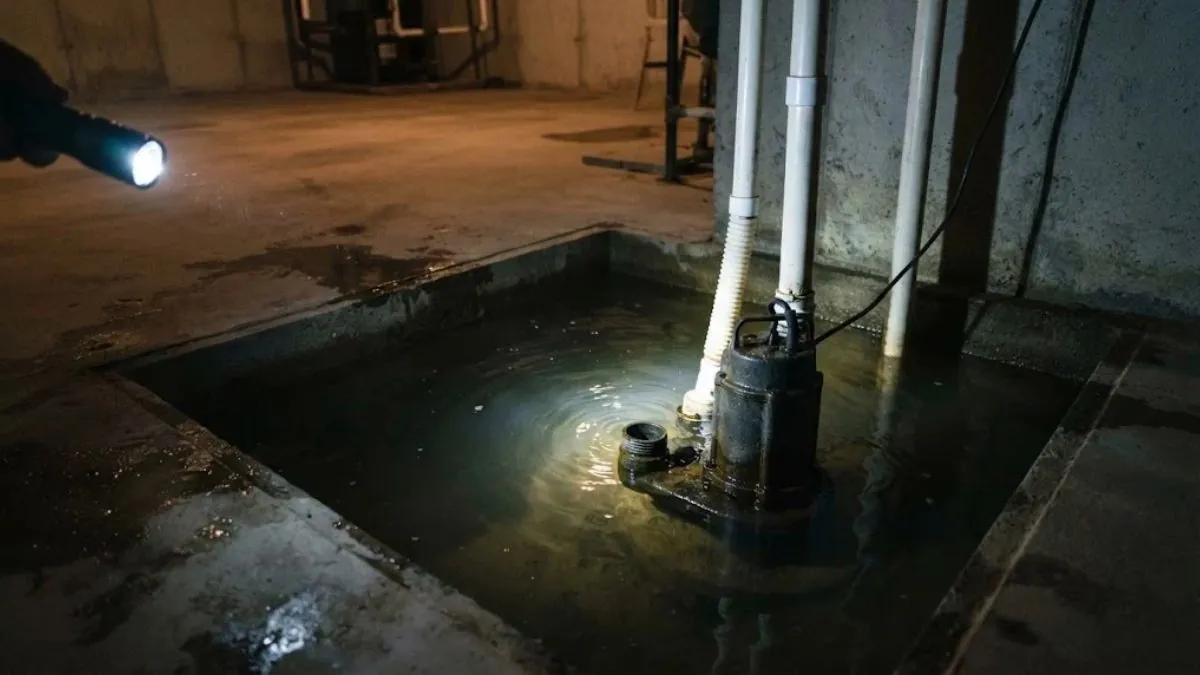
First, protect yourself
Water and electricity are the real danger in a flooding basement. Do not wade into standing water if the panel, outlets or appliances are in it. If water is rising toward the electrical panel, leave the basement and call your electric utility or an electrician about shutting off power from outside. A wet basement is not worth an injury.
If the water is shallow, the pump's outlet is dry and you are not standing in water, you can check the pump's plug. Otherwise, stay out and call.
Quick checks in order
Is there power?
Check the GFCI on the outlet and the breaker. A tripped GFCI is the most common reason a pump stops.
Is the float free?
The float switch can jam against the pit wall or hang up in the basin. Lifting it by hand, if safe, tells you whether the pump runs.
Is the pump humming?
A hum without pumping can mean a jammed impeller or a failed capacitor. Do not reach into the pit while it is plugged in.
Is the discharge open?
Look outside at the end of the discharge pipe. Ice, debris or a crushed line can block it, and then the pump has nowhere to push the water.
What the 2021 storm showed
On 1 and 2 September 2021 the remnants of Hurricane Ida brought roughly 6 to 8 inches of rain to Chester County in a matter of hours. Chester County Emergency Services reported more than 4,000 calls and over 300 rescues in ten hours, and Brandywine Creek crested at record levels. West Chester Borough saw downed trees and flooded roads.
Many basements stayed dry that week and many did not. The difference often came down to the pump: whether it was a good one, whether the power stayed on, and whether the discharge could carry the volume. A backup system makes the difference when the main pump or the power fails.
Backup options compared
| Backup | Runs on | Keep in mind |
|---|---|---|
| Battery backup pump | A deep-cycle battery | Test it and replace the battery on a schedule |
| Water-powered pump | Municipal water pressure | Needs municipal water and uses water to work |
| Second pump with a generator | Generator power | Needs fuel and someone home |
| High-water alarm | Battery | Warns you, does not pump |
Whichever you choose, test the whole system before storm season by pouring a bucket of water into the pit and watching the pump start and finish.
Pump out and water rising?
Call the 24/7 line. A plumber can talk you through shutoffs.
After the water goes down
Once the pit is emptying again, check what failed. A pump that ran for days may be near its end even if it started again. A float that stuck once will stick again.
A discharge that froze will freeze in the next cold snap. If the pump is more than about ten years old, replacement is usually cheaper than repeating a midnight call.
For the long term, basement waterproofing looks at why so much water reaches the pit in the first place. Gutters, grading and drainage can lower the load on the pump, and a new sump pump installation with a backup finishes the job.
A storm-ready checklist
A note on East Bradford homes near the creek
Properties near the East Branch of the Brandywine and its feeder streams see groundwater rise faster than those on higher ground. If your property sits in a creek valley, a pump that never struggled on a typical storm may struggle in a long one. Tell the plumber where you are in the valley when you describe the problem, because the answer to "how big a pump" depends on it.
Sizing a replacement pump
A pump is sized by how much water it can move against the height it must lift, called head. A pump rated at a given number of gallons per hour at ten feet of head will move less at fifteen. The discharge line length, bends and the check valve add resistance too. A plumber looks at the pit, the discharge route and the typical inflow, and recommends a horsepower that has margin.
Bigger is not always better. An oversized pump in a small pit can cycle too fast, which wears the switch and the motor. The right pump is one that clears the pit quickly without short-cycling, and that has a reliable float switch.
Float switch types
| Type | Advantages | Concerns |
|---|---|---|
| Tethered float | Common and inexpensive | Can tangle on the cord or pit wall |
| Vertical float | Fits narrow pits | Can stick on the guide rod |
| Electronic sensor | No moving parts to snag | Costs more |
| Diaphragm switch | Sealed from debris | Can fail if the air line clogs |
Check valves, discharge lines and what happens outdoors
The check valve keeps water from falling back into the pit after the pump stops. A failing one makes the pump cycle on and off, and you may hear a thud as water drops back. The discharge line should end well away from the foundation, on ground that slopes away, or the pumped water simply returns to the pit.
In winter, the end of the discharge pipe can freeze shut. A discharge fitting with a relief opening, or a line that drains after each cycle, reduces the risk. If a storm arrives during a hard freeze, check the end of the discharge before it matters.
Where to go next
The pump itself is covered in the details, the long-term fix in the details, and creek-valley conditions on the East Bradford page.
Sources and standards
Sources: Chester County Emergency Services figures for the September 2021 storm as reported by Patch, and National Weather Service and county statements on the Brandywine floods. Electrical safety guidance follows the National Electrical Code (NEC) rules on GFCI protection.
Sump pump storm questions
Only if the cord and outlet are dry and you are not standing in water. A pump that runs nonstop is usually responding to high water, not broken.
Many are built for heavy duty but not unlimited. A pump running for days is a signal to call.
Standard policies often exclude groundwater and sump failure unless a water backup endorsement was added. Check your policy.
Often around ten years, sooner with heavy use.
A battery or water-powered backup keeps the pit emptying. Without one, the pump stops with the power.